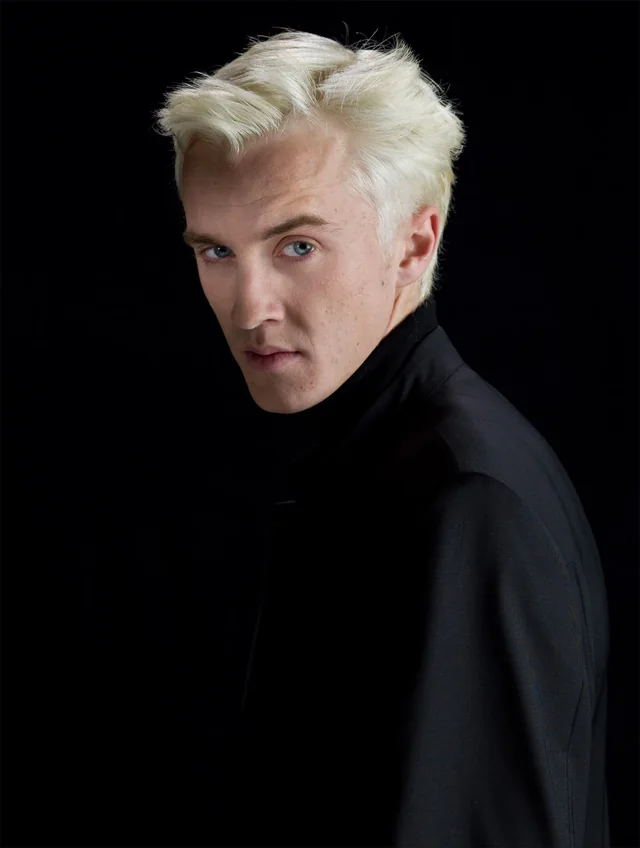
Harry Potter · Personality profile
Draco Malfoy Personality & Traits
Draco Malfoy is status-conscious, competitive and increasingly guarded when the demands of his family become dangerous. His early confidence comes from knowing which rules favour him. His later scenes are about what he does when those rules stop offering protection.
Harry’s school rival and heir to the Malfoy family. Slytherin.
Played by Tom Felton in the original films.
Includes spoilers for the original novels.
Draco Malfoy’s personality traits
Reads a room as a hierarchy
In Philosopher’s Stone, Chapter 6, Draco approaches the famous new student on the train and signals that Ron belongs to the wrong group. He offers Harry access to a social map inherited from his parents. The scene is concise evidence for how a child can reproduce a hierarchy long before he questions whom it harms.
Resourceful in private, afraid in public
In Half-Blood Prince, Chapter 27, Draco has already worked around Hogwarts security by repairing a Vanishing Cabinet. On the Astronomy Tower, the private work gives way to a confrontation he cannot control. His hesitation with Dumbledore reveals a distance between wanting to prove himself and being able to do what Voldemort expects.
Hesitant under pressure from his own side
In Deathly Hallows, Chapter 23, Draco is asked to identify the captured Harry at Malfoy Manor and gives an uncertain answer. The books leave room to argue over whether he is afraid of a mistake, reluctant to help or both. That uncertainty is more faithful to the scene than treating it as a complete reversal of everything he has done.
Key relationships
Harry Potter. Harry rejects Draco’s first offer of friendship. Their rivalry continues to confront Draco with choices beyond the ones his family taught him.
Hermione Granger. Draco’s treatment of Hermione shows the costs of his inherited prejudice. Their use of preparation and strategy serves sharply different ends.
What Draco knows how to control
Draco does much of his sixth-year work out of sight. An object can be tested and repaired in private; a conversation with Dumbledore creates obligations he cannot solve by trying the mechanism again. Bringing these two tasks together helps explain why Draco can be persistent and ingenious for months and then visibly struggle when another person asks him to take responsibility for the result.
What a Draco Malfoy quiz result means
You notice incentives and think ahead about what happens if the first plan fails. That strategic awareness is the part of Draco this result reflects. It’s most constructive when the people around you know what you’re trying to protect or achieve.
Draco Malfoy FAQ
How does Draco become master of the Elder Wand?
Draco disarms Dumbledore on the Astronomy Tower, so the wand’s allegiance passes to him even though he never uses it. Harry later overpowers Draco at Malfoy Manor. That chain is easy to miss on a first reading, because the people openly pursuing the wand focus on who possesses it.
Does Draco Malfoy change sides in the books?
Draco’s later choices become harder to read as straightforward loyalty to Voldemort. He hesitates when asked to identify Harry at the Manor, but also tries to capture Harry in the Room of Requirement. Both scenes matter if you want to understand his actions without assuming he has declared a new allegiance.
Why does Draco care so much about his surname?
At Hogwarts, Draco treats the Malfoy name as a guide to where people stand and what he can expect from them. His parents give him the social rules he repeats early in the series. As Voldemort turns the family’s status into a liability, Draco discovers what that inheritance actually demands.
What does a Draco result measure?
The quiz reads Draco through the practical characteristics it can ask about in ordinary situations. It gives weight to noticing who makes a decision, planning a backup before negotiating and protecting the strongest part of a project when time runs short. That describes a way of responding under pressure.